River Worth Friends
  • Home
  • Events
  • What we do
  • Meet our volunteers
  • Blog
  • Report an incident
  • Get in touch
  • River Worth Friends Policies and constitution

Monitoring the ecological status of the worth -part one - electrofishing.

6/12/2025

1 Comment

 
Picture
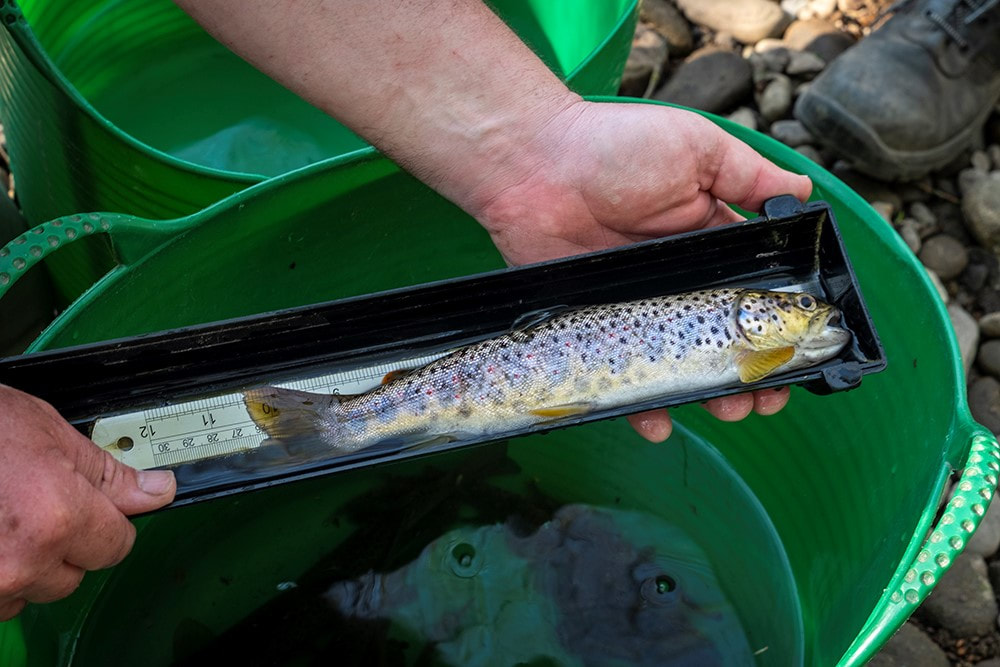
Measuring a brown trout, 260mm.
​River Worth Friends and the Aire Rivers Trust have been monitoring the ecological status of the Worth for a number of years. We have used two methods for this; electrofishing to count the actual number and species of fish and riverfly monitoring to count the number of invertebrates (bugs) living in the river, on which the fish feed. As we have been doing this for about five years we can start to detect trends in the numbers. In this blog we will look at how we electrofish and then analyse the results.
​
​Electrofishing involves passing an electric current through the water to momentarily stun or disorientate the fish, making them easier to catch, we then take a count and measure the length of some species. You may have seen us demonstrating this at the Trout in the Town Conclave we hosted earlier this year. Fishing usually involves a team of 4 to 6 people, headed by Prof. Jon Grey of the Wild Trout Trust who wields the electric probe, there are two catchers with nets who scoop up the fish when they appear and pass them to the fourth person who keeps them in a bucket of water for later counting and measuring by one or two people on the bank. I said that the stunning makes the fish easier to catch but the job of the catcher is quite tricky as the fish are only briefly immobilised so you have to be quite quick witted and sure footed.
Picture
Electrofishing team, left to right, catcher, bucket holder, Prof Grey with probe, catcher
​Once counted and measured the fish will be fully recovered and are released back into the river.
Five approximately 50 metre stretches are fished each spring. The lowest is by Kinara Close whilst the most upstream is at Damems.
​We asked Prof. Grey to explain some of the trends showing from the data over the past five years:
  • We have sampled the five sites consistently between years to standardise as much as possible so any differences are down to environmental elements, not the surveying approach per se. 
  • We would expect inter-annual fluctuation in numbers to some extent to do with differing conditions throughout the intervening year affecting various different life-stages
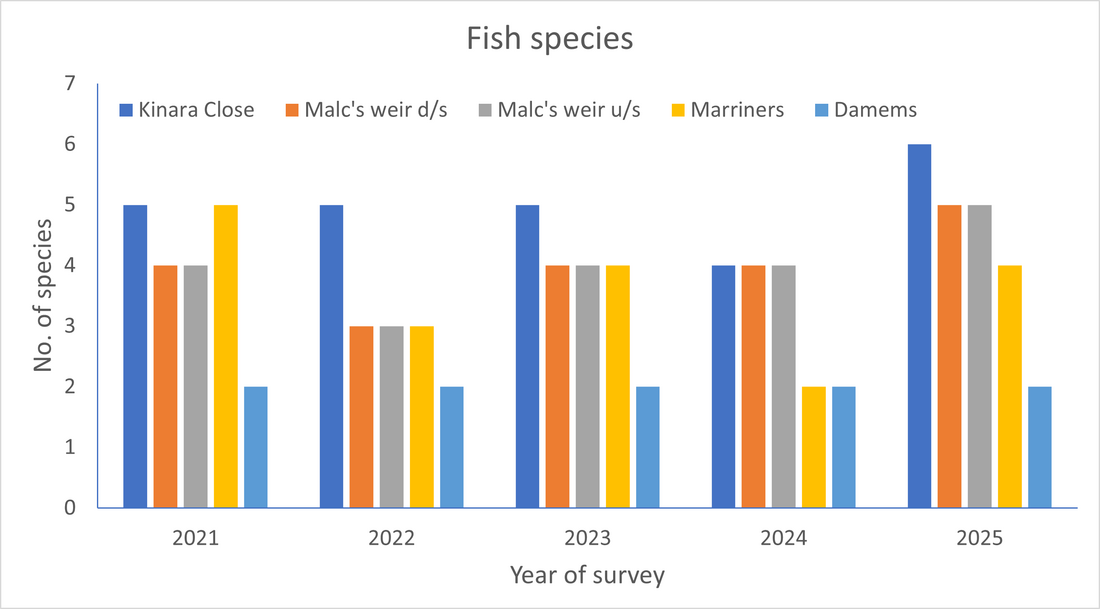
  • I've drawn up a bar chart denoting fish species number at the different sites over time. We would expect that there should be greater fish species diversity at the furthest downstream site and that generally holds but is clearest in 2025. There are a greater number of fish species in the mainstem Aire which 'should' be able to access the lowest reaches of the Worth. Over the five years of the survey, we have caught 8 different species: brown trout, grayling, bullhead, gudgeon, stone loach, minnow, 3-spined stickleback, brook lamprey. But interestingly the bar chart shows that the maximum we have caught at one time point at one location is 6.
Picture
​
  • At Damems, representing an upper section, we would naturally expect fewer fish species because of the gradient of the river and the suitability of the habitat whittling out those species that aren't able to cope. Of course, the Worth is challenged by weirs which further constrain that scenario. Damems has only ever had bullhead and brown trout in surveys and that is maybe a natural community for the river up there, although one might argue brook lamprey and eel should be able to get there if there were no weirs.
  • Complicating the picture of fish distribution further is the fact that bullhead and trout have sustainable populations above all the weirs and most of the pollution sources so can repopulate from upstream. Almost everything else has to repopulate from downstream. 
  • I say almost above. There seems to be a pocket of stickleback and brook lamprey clinging on above the goit and weir at Marriners walk which boost the species number occasionally
  • Still on species: gudgeon only appeared in surveys in 2025, and grayling appeared in 2024 with slightly more in 2025, demonstrating slow return of species to the river from the mainstem Aire but being limited by weirs. Indicative of this, minnow can be quite numerous in some years but only 1 minnow has been recorded in our surveys above the weir above the A629 at Aireworth Grove (we call it Malcolm’s weir).
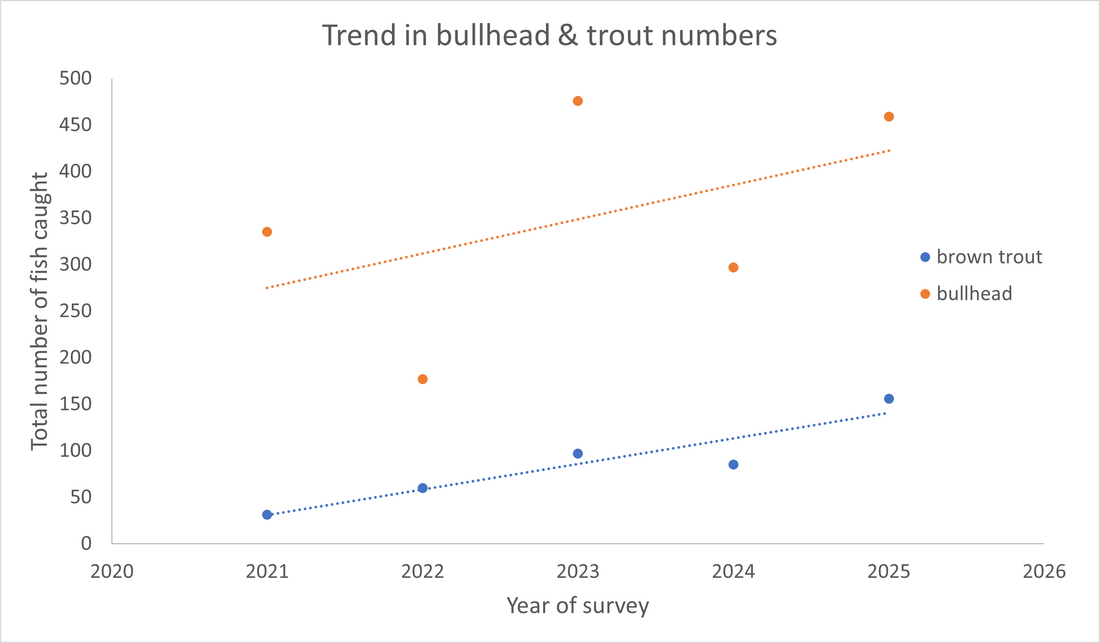
  • ​For health of the river in terms of fish numbers, I've restricted the figure to bullhead and trout, and the general trend over time is that numbers of both are increasing at roughly the same trajectory. Bullhead numbers are much more irregular, being smaller species and with quicker turnover rates, and reflect that of stone loach and minnow to a certain extent. If we converted the raw numbers to density ie per unit area then the values would still be considered quite poor, but the trajectory is in the right direction and coupled with increasing diversity, seem to imply that the fish community is recovering.
Picture
​
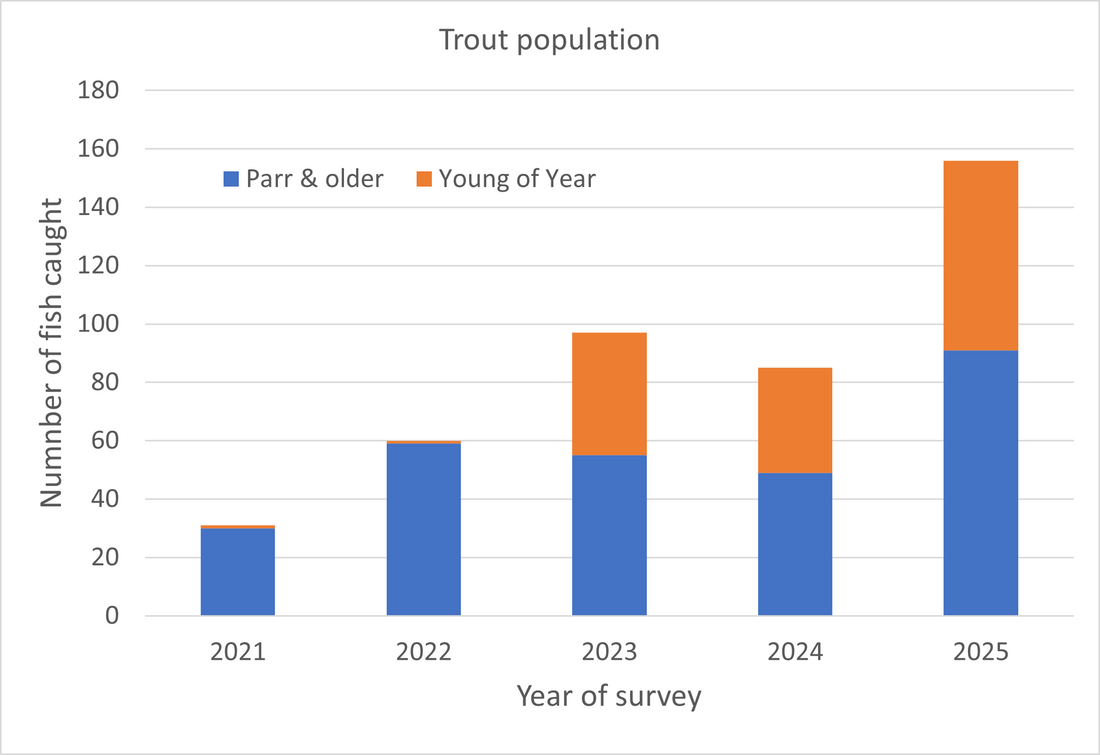
  • The trout data can be explored even further, so in the last figure I have totalled the trout caught but split the numbers into parr (juveniles >1 year) and older fish, and the young of year component (fry <1 year). If we just look at the parr & older component of the population firstly, then the trend is much flatter than the previous figure; indeed, there is little change between 2021-24 and it is only in 2025 that the number jumps up a bit. Such a pattern might imply that the ‘carrying capacity’, the available habitat or food resource for older trout in the Worth, may be limiting. Interestingly, it is the fry component that has really changed over the 5 years of survey and caused the more marked upward trend in total trout number. Being the most delicate life-stage, fry numbers are extremely ‘noisy’, affected by a greater range of parameters and are thus more difficult to interpret. We only recorded one fry in each of 2021 and 2022. I know from surveying many becks across the region that 2021 & 2024 were relatively ‘good’ years ie lots of becks had higher numbers of fry but 2022 & 2025 were generally poor for various reasons. The Worth data do not seem to conform and may simply be reflecting the overall recovery of a river more able to support the earliest life-stages….watch this space!  
Picture
Our thanks to Prof. Grey for that interesting analysis. That last graph is particularly enigmatic, will the 2026 results show a continuing upward trend of older fish due to the recruitment from the previous young of year? We will let you know.
1 Comment
Shaun Leonard link
12/12/2025 09:30:12 am

Very interesting and hopefully, in the sampling noise, some encouraging news. You guys striving valiantly for the Worth (and wider Aire) deserve it! Well done.

Reply


Leave a Reply.

    Archives

    November 2025
    October 2025
    September 2025
    January 2025
    October 2024
    September 2024
    July 2024
    June 2024
    June 2023
    April 2023
    March 2023
    January 2023
    October 2022
    June 2022
    March 2022
    February 2022
    January 2022
    November 2021
    September 2021
    August 2021
    July 2021
    June 2021
    May 2021
    April 2021
    March 2021

    Categories

    All

    RSS Feed

Site powered by Weebly. Managed by JustHostMe Limited
  • Home
  • Events
  • What we do
  • Meet our volunteers
  • Blog
  • Report an incident
  • Get in touch
  • River Worth Friends Policies and constitution